How to Spot Fake Instagram Followers (Yours or Anyone's)
Fake followers are easiest to catch in the ratios, not the follower list. Here are the signals that give an inflated account away, and the threshold that matters.
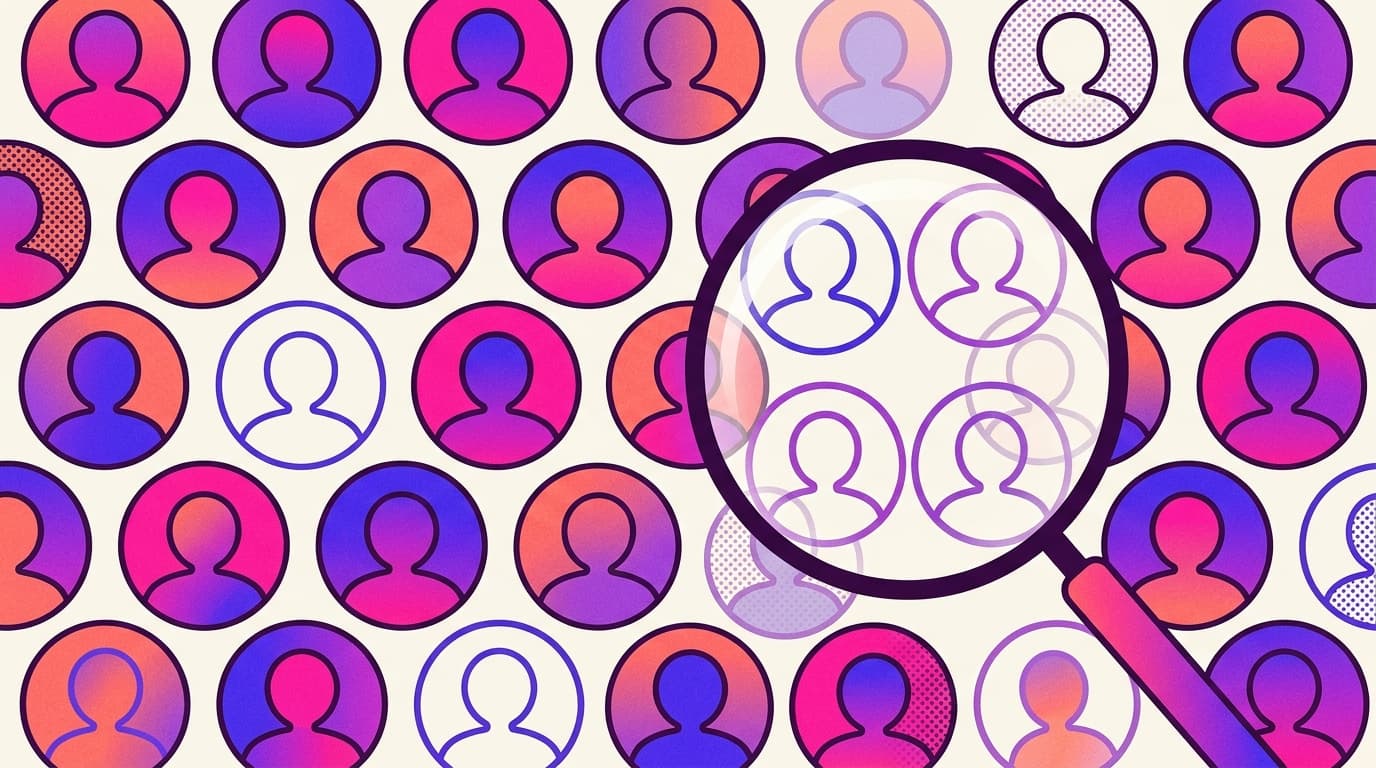
You spot fake Instagram followers in the ratios, not by scrolling the follower list. An account with 200,000 followers and 300 likes per post is telling you something arithmetic that no bio inspection would reveal.
This matters whether you are vetting a creator to pay, or working out why your own reach has quietly collapsed.
Key Takeaways
- Engagement that does not scale with audience size is the strongest signal.
- Modash recommends walking away above 25% fake followers (Modash).
- Fake followers depress reach mechanically, not just cosmetically.
- Instagram's 2026 engagement average was 0.48%, so use tier benchmarks, not instinct.
Start with the engagement ratio
Take the account's typical likes and comments, divide by follower count, multiply by 100. Then compare that against what accounts of that size actually earn.
Instagram's platform-wide engagement rate averaged 0.48% in 2026, down 24% year over year (Socialinsider, 2026). Smaller accounts run considerably higher, larger accounts lower. The pattern is consistent enough that a sharp deviation is worth investigating.
The tell is not a low rate on its own. Plenty of legitimate large accounts sit below 1%. The tell is a rate far below the norm for that specific tier, combined with the other signals below. One signal is noise. Three together is a pattern.
Read the follower growth curve
Real accounts grow in a jagged upward line: flat stretches, small steps, occasional spikes when something travels.
Bought followers produce a different shape entirely. A vertical jump of several thousand in a day or two, with no corresponding spike in engagement, is the classic signature. So is a staircase, where the count climbs in identical increments at regular intervals, which is what a drip-fed purchase looks like.
The catch is that Instagram Insights only covers a recent window of roughly 90 days, so the historical curve is not available natively. If you are auditing your own account, you need the growth recorded as it happened. If you are auditing someone else's, a tool that has been tracking public accounts over time can show you the shape that the profile page hides.
Check the comments, not just the count
Comment quality degrades in a recognisable way when it is bought.
Look for comments that could attach to literally any post: single emoji, "nice", "great content", "🔥🔥🔥". Look for the same handful of accounts commenting on every post within minutes, which is an engagement pod rather than an audience. Look for comments in a language that has no relationship to the content or the creator's market.
Real audiences reference the actual post. They ask questions, disagree, tag a specific friend for a specific reason. That texture is difficult to fake at volume and is the fastest qualitative check available.
Modash's walkthrough covers the mechanical version of this check.
Audience geography that does not add up
An account posting in Italian about Milanese restaurants, with 40% of its audience in regions where neither the language nor the subject has a natural market, has a problem.
Follower farms sell from wherever they operate, and the geography leaks. This check is only available for accounts you own or have been granted access to, since audience demographics are not public, but it is decisive when you have it.
For creator vetting, ask the creator for a screenshot of their audience breakdown. A creator with a clean audience will send it without hesitation. Hesitation is itself information.
The threshold that matters
Some inauthentic audience is unavoidable. Bots follow accounts unprompted, and every large account accumulates dormant profiles over time. A small percentage is normal.
Modash, which analysed the audiences of Finnish influencers and found 6.2 million fake followers amounting to roughly 18% of the total audience, recommends avoiding any creator above 25% fake followers, the point at which purchased followers become very probable (Modash). In that study, 11 of the 100 accounts analysed had fewer than half their followers real.
So the practical rule: under 10% is unremarkable, 10% to 25% warrants a closer look at the other signals, and above 25% is a walk-away for paid work.
Why this hurts your own account
If the account in question is yours, the damage is not reputational, it is mechanical.
Instagram decides how widely to distribute a post partly on how quickly the people who see it first respond. Fake followers never respond. They sit in your follower count inflating the denominator of every ratio, and they dilute the early-signal pool that determines whether a post gets pushed further.
The result is that a bought audience makes every subsequent post reach fewer real people. It is the rare growth tactic that actively reverses growth. Our guide to Instagram engagement rate covers how that denominator works in practice.
Cleaning up
There is no bulk removal tool. You can remove followers individually from your follower list, and Instagram periodically purges bot accounts on its own, which is why heavily inflated accounts sometimes drop thousands overnight.
For an account with a serious problem, the realistic path is to stop adding to it and grow past it. As real followers arrive and fake ones get purged, the ratio recovers. It is slow, and it is considerably faster than the alternative of continuing to buy.
The one thing not to do is buy engagement to mask the follower problem. That compounds both signals and makes the account harder to diagnose later, including for you.
Frequently asked questions
How can you tell if an Instagram account has fake followers?
The clearest signal is engagement that does not match audience size: a 200K account earning 300 likes is arithmetically implausible. Sudden vertical jumps in follower count, comments that are all emoji, and an audience concentrated in countries unrelated to the content all point the same way.
What percentage of fake followers is too many?
Modash recommends avoiding creators above 25% fake followers, the threshold at which purchased followers become very probable. Some inauthentic audience is unavoidable on any account, so a small percentage is normal rather than damning.
Do fake followers hurt your account?
Yes, mechanically. They inflate your follower count without ever interacting, which drags down your engagement rate and weakens the early signals Instagram uses to decide how far to distribute a post. A bought audience makes every future post reach less.
Can you remove fake followers from Instagram?
You can block or remove followers manually from your follower list, and Instagram periodically purges bot accounts itself. There is no bulk removal tool, so for a heavily inflated account the practical route is to stop buying and let the ratio recover as real followers arrive.
How do I check an influencer's followers before working with them?
Compare engagement rate against benchmarks for their follower tier, look at the follower growth curve for unnatural steps, read a sample of comments for generic filler, and check whether audience geography matches the content language.
Francesco Vagliante
Founder, OwlStat
Founder of OwlStat. Building Instagram, TikTok and YouTube Shorts analytics used by agencies and creators to measure what actually grows an account.
@francescovaglia