How to Grow on Instagram in 2026: What the Growth Data Shows
You grow on Instagram when people who don't follow you see a reel, watch it, send it, and then find a profile worth following. Set the bar first: in OwlStat's daily readings, the typical account with 5K to 50K followers grew almost 0% in a month, while the top 10% grew more than 3%.
 Francesco Vagliante15 min read
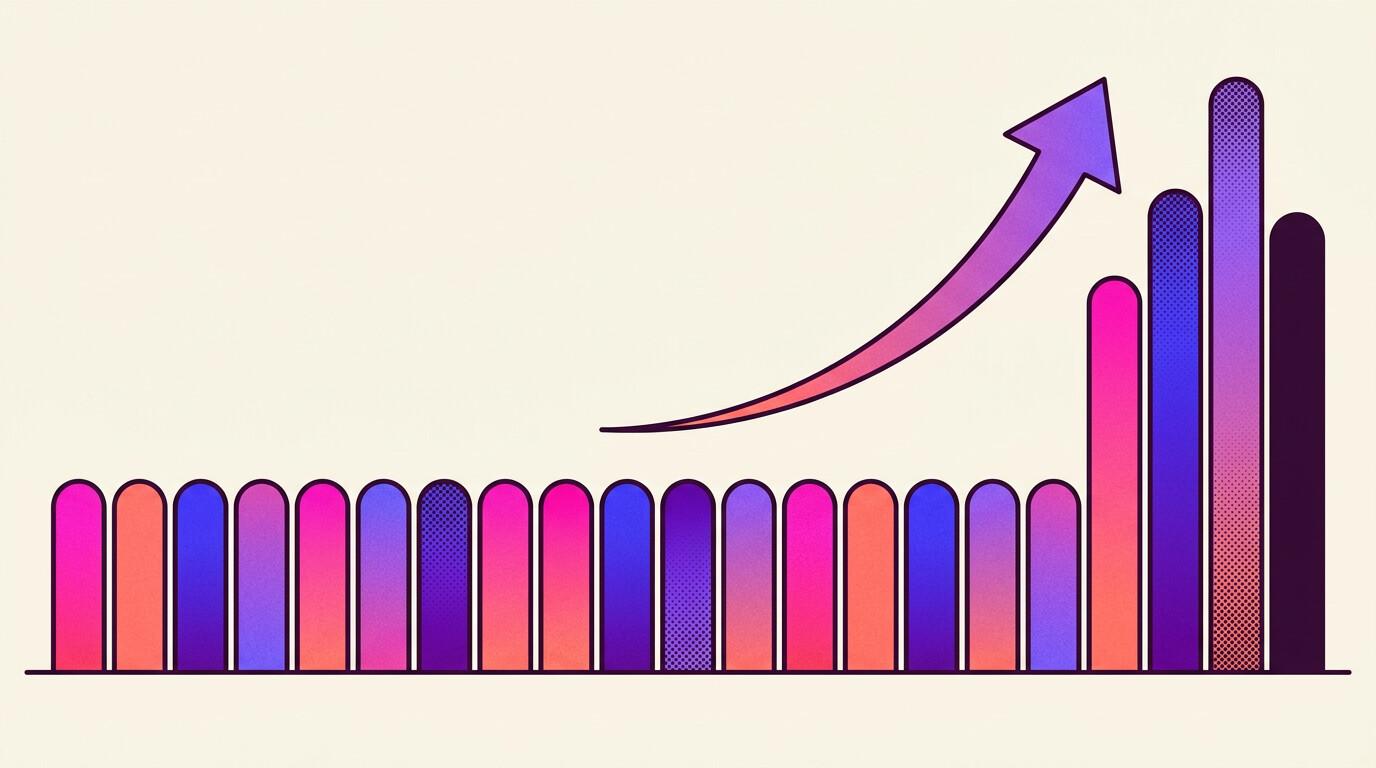
You grow on Instagram when people who don't follow you yet see your work, mostly through reels they watch and send to someone, and then land on a profile that gives them a reason to follow. Instagram's own creator FAQ says it directly: "as your reel is shown to more people who don't follow you, the likelihood of new followers goes up" (Instagram Creators, checked November 2026). And set the bar before any tactic: in OwlStat's daily readings of 4,007 public accounts, the typical account with 5K to 50K followers grew by almost exactly zero in the 30 days to November 24, 2026.
That number changes what "growing" means, so this guide starts there. Then it covers what Instagram has said brings in new followers, how to test reels on strangers, how to turn a view into a follow, how often to post, and which old tactics now cost you reach.
Key Takeaways
- Most accounts don't grow. In the 30 days to November 24, 2026, the median account with 10K to 50K followers gained 0.01%, and only 51% of them ended the month up (OwlStat).
- Growing means beating your size tier: above +1.03% a month at 10K to 50K you are in the top quarter, above +3.29% in the top 10%.
- New followers come from non-followers. Mosseri says send rates matter more for people who don't follow you, and like rates for people who do.
- Instagram found that creators with the fastest net follower growth post, on average, 10 or more reels a month.
- Reel insights show a Follows number for every reel. Ranking your reels by follows, not views, tells you what actually grows the account.
How fast do Instagram accounts actually grow?
Slower than every "get 1,000 followers fast" headline suggests. OwlStat reads public Instagram accounts every day, and its follower growth benchmarks compare each account with itself 30 days earlier. This is how the month to November 24, 2026 looked, across 4,007 public accounts with at least 5,000 followers:
| Followers | Accounts | Median month | Top quarter | Top 10% | Ended the month up |
|---|---|---|---|---|---|
| 5K-10K | 531 | +0.02% | above +1.05% | above +3.05% | 50% |
| 10K-50K | 1,270 | +0.01% | above +1.03% | above +3.29% | 51% |
| 50K-100K | 418 | +0.20% | above +1.34% | above +4.02% | 59% |
| 100K-1M | 1,147 | +0.14% | above +0.95% | above +2.45% | 57% |
| 1M+ | 641 | -0.14% | above +0.37% | above +1.28% | 41% |
Source: OwlStat, Instagram follower growth benchmarks, measured November 24, 2026. Growth is followers now minus followers 30 days ago, divided by followers 30 days ago. Private accounts and accounts tracked in bulk by agencies are left out, and the sample leans toward brands and creators who watch their numbers. The figures are recomputed every 12 hours, so the live ones will have moved.
Read the median column as people. An account with 20,000 followers at the median gained 2 followers, net, in a month. Almost half the accounts in that tier did not end the month ahead. In every tier, a quarter of accounts lost more than 0.28% to 0.37% of their followers. Past a million followers, the typical account shrank.
So "how do I grow" really means "how do I get into the top quarter of accounts my size." At 10K to 50K, the top quarter starts at +1.03% a month, which is 206 net followers on 20,000. The top 10% starts at +3.29%, or 658. Even that top pace compounds slowly: at 3.29% a month an account doubles in about 22 months. At the top-quarter pace it takes over five years.
Two things follow. First, a flat month is normal, not a sign that something is broken. Second, the accounts that do grow have to beat the median account on something specific. The rest of this guide is about what Instagram itself says that something is. (The study starts at 5,000 followers, so there is no tier here for smaller accounts.)
Where do new followers come from in 2026?
From people who don't follow you, and Instagram decides who sees you based on what earlier viewers did.
Reels are the door. Adam Mosseri, head of Instagram, explained in 2023 that in Reels, "the majority of what you see is from accounts you don't follow" (Instagram, 2023). Instagram's creator FAQ adds that "reels are the best way to reach new audiences" (Instagram Creators, checked November 2026). Stories go to people who already follow you. They keep an audience; reels build one.
Sends decide how far a reel travels. In January 2025 Mosseri named "watch time, likes and sends" as the three signals that matter most for ranking, and told creators to watch "average watch time, likes per reach, and sends per reach" in their insights (Social Media Today, 2025). In May 2026 he split them by audience: "like rates matter more for your followers, and send rates matter more for those who don't follow you" (Social Media Today, 2026). For growth, sends per reach is the number to move. Our post on Instagram saves and shares covers what makes people forward a post.
Search, inside and outside Instagram. Mosseri has written that the text people type is "by far the most important signal for Search," and that Instagram tries to match it "with relevant usernames, bios, captions, hashtags and places." His advice: a handle or profile name "related to the content of your posts," and "relevant keywords and locations in your bio" (Instagram, 2021). So the words people would type to find you belong in your name, your bio and your captions. Google matters too. Instagram allows search engines to index public posts and reels uploaded from January 1, 2020 onward from accounts that are public, professional and held by someone over 18 (Instagram Help Center, checked November 2026), and on July 10, 2025 Instagram changed how some posts are made available to Google, a change it told Social Media Today is "being gradually rolled out around the world" (Social Media Today, 2025). A caption that says plainly what the post is about can bring in visitors from a Google search. You can turn this off in your privacy settings.
Other people's audiences. Since August 2025 other accounts can repost your public reels and feed posts, and those reposts are "recommended to your friends' and followers' feeds" and "credited to the original poster" (Meta, 2025). A reel worth reposting reaches people you would never reach alone.
How do you test a reel on people who don't follow you?
With trial reels, the closest thing Instagram offers to a growth lab. Meta announced them in December 2024: "Trial reels will be shown to non-followers first." You can share a trial with your followers with one tap, or let Instagram do it "if we determine it's performing well based on the views it receives within the first 72 hours" (Meta, 2024, updated 2025).
Access has shifted. In June 2025 Meta said it had "made trial reels available to everyone" (Meta, 2025), while Social Media Today reported in July 2025 that they were available to creators "with at least 1,000 followers and an account set to 'Public'" (Social Media Today, 2025). If the toggle isn't there for you, those two conditions are the first thing to check. In April 2026 Instagram announced that you can also schedule when a trial goes out to non-followers (Social Media Today, 2026).
Why this matters for growth specifically: a normal reel also reaches your followers, who already like you, so its numbers flatter it. A trial goes to non-followers first, the people you are trying to win. Use trials for the ideas you are least sure of, a new format, a new topic, a hook you would not normally try. Then judge each trial by follows and sends, not by views. A trial with modest views and a lot of follows is a better template than a viral one that brought nobody to your profile.
How do you turn a view into a follow?
A reel gets someone to your profile. The profile decides whether they stay.
Think about what a stranger sees when they tap through from a reel: your name, your bio and the top of your grid, all on one screen. If that screen doesn't say what the account is about, the reel did its job and the profile wasted it. Instagram's own search advice points the same way: a name "related to the content of your posts" and "relevant keywords and locations in your bio" (Instagram, 2021) are what tell a new visitor, and the search engine, what you do.
The top of your grid is now yours to arrange. Instagram moved profile grids from squares to rectangles in January 2025 (PetaPixel, 2025), and since June 2026 you can rearrange the posts on your grid (Gizmodo, 2026). Put the nine posts that best show what a new follower will get at the top, and make sure a stranger can tell your topic from them alone.
Then measure the step that matters. For every reel, Instagram's insights show Follows: "how many accounts started following you as a result of viewing your reel," next to Views, which counts every time the reel "starts to play or replay" (Instagram Help Center, checked November 2026). Divide follows by views and multiply by 1,000 to get follows per 1,000 views, then sort your last 20 reels by it. There is no public benchmark for this number, so your own median is the baseline. The reels at the top of that list are the ones worth making again, and they are often not your most viewed. Our guide to Instagram Reels analytics walks through every other number on that screen.
How often should you post on Instagram to grow?
About 10 reels a month is the floor, if follower growth is the goal. That number comes from Instagram, not from a vendor: "when we look at creators with the greatest net follower growth rates we see, on average, they post 10 or more reels per month." Instagram adds that frequency "is just one factor of many" (Instagram Creators, checked November 2026).
Read that as a correlation. Accounts that grow fastest may post more because they have a team, or because growing feels worth the effort. Still, the logic holds on its own: someone who discovers you through one reel and taps through to your profile is more likely to stay if there are recent reels waiting for them, and more likely to see you again in their feed if you keep posting.
So: two or three reels a week, every week, beats seven in one week and none for a month. Go above that only if the quality holds: a rushed reel that nobody finishes or sends adds a post, not followers. Feed posts and Stories are for keeping the people you win; count them on top of the reels, not instead of them.
What stopped working?
Four tactics that fill older growth guides now range from useless to harmful.
Stuffing hashtags. In December 2025 Instagram announced it would gradually limit hashtags to five per post or reel, and Mosseri had already said that hashtags "don't work" to increase reach (Social Media Today, 2025). Instagram's creator FAQ still says trending hashtags relevant to your reel can help you reach people "interested in those topics specifically" (Instagram Creators, checked November 2026). Use a few that describe the post, then move on. Your name, bio and caption carry the same words search matches on.
Reposting other people's content. Instagram said on April 30, 2026 that "accounts that primarily post unoriginal content in photos or carousel posts, in addition to reels, will no longer be shown in places where we recommend content." Instagram adds that "75% of recommendations in the US" now come from original posts (Instagram Creators, 2026). A meme page built on reposts has lost its growth engine.
Very long reels. Instagram lets you upload reels longer than three minutes, but its creator FAQ lists reels longer than 3 minutes among the things that can limit your distribution, and says it recommends videos to unconnected audiences, people who don't follow you, that are 3 minutes or less (Instagram Creators, checked November 2026). Keep the reels meant to win new followers at three minutes or under.
Bought followers, follow-unfollow apps and pods. Since 2018 Instagram has been "removing inauthentic likes, follows and comments from accounts that use third-party apps" to boost their popularity (Instagram, 2018). Fake followers don't watch or send, so they lower the very signals that bring real people. Our guide to spotting fake Instagram followers shows how they look from the outside, which is how a brand will look at you.
How do you know if your growth is working?
Compare your month with accounts your size, not with a creator who went viral.
Your follower trend. Instagram's account insights show "Growth (number of followers you've gained or lost)" once you have at least 100 followers (Instagram Help Center, checked November 2026). Put your last 30 days next to the table above. At 10K to 50K, +0.5% beats the median, and anything above +1.03% puts you in the top quarter.
Your engagement against your tier. Growth and engagement are separate numbers, and you want both. In OwlStat's Instagram engagement benchmark study of 22,646 public accounts (August to October 2026), the median engagement rate is 1.38% at 1K to 10K followers and 0.68% at 10K to 50K, and in every tier from 1K followers up the top quarter starts at 7 to 12 times the rate where the bottom quarter ends. Size explains less than people think. You can place any public account in that table with the free engagement calculator.
Your history. One month says little; six months show a trend, and which posts started it. OwlStat's Instagram analytics tracks follower growth, engagement rate, reach and your top posts from the official Meta Graph API, and stores that data from the day you connect the account, so you can see which reels came right before your best weeks.
What I would do
- Set the right target. Find your tier in the growth table and aim for its top quarter, not for a viral month.
- Post 10 or more reels a month, two or three a week, three minutes or under, all original.
- Use trial reels for the riskiest third of your ideas, and judge them by follows and sends.
- Fix the first nine posts on your grid so a stranger can tell at a glance what they will get, and put the words they would search for in your name field.
- Rank your reels by follows per 1,000 views, monthly, and make more of the top five.
- Drop what stopped working: hashtag stuffing, reposts, growth apps.
- Keep a record. Compare each month with your tier, and with your own last six months.
None of this is secret. Instagram has said what it rewards: reels that strangers watch and send, original work, and a steady 10 or more a month. The step most accounts skip is checking which reels brought followers, not which ones brought views, and making more of those.
Where to go next
- How the Instagram algorithm works: the signals behind Feed, Reels, Stories and Explore in more depth.
- Instagram saves and shares: the two interactions that carry a post past your followers.
- How to see who unfollowed you on Instagram: what normal follower loss looks like, and why a drop happens.
Sources
- OwlStat, "Instagram follower growth benchmarks," 4,007 public accounts with 5,000+ followers, 30 days to November 24, 2026: https://owlstat.io/instagram-follower-growth-benchmarks/
- OwlStat, "Instagram engagement rate benchmarks 2026," 22,646 accounts, August to October 2026: https://owlstat.io/instagram-engagement-benchmarks/
- Instagram Creators, FAQ, checked November 2026: https://creators.instagram.com/faq
- Instagram, Adam Mosseri, "Instagram Ranking Explained," May 31, 2023: https://about.instagram.com/blog/announcements/instagram-ranking-explained
- Instagram, Adam Mosseri, "Breaking Down How Instagram Search Works," August 25, 2021: https://about.instagram.com/blog/announcements/break-down-how-instagram-search-works/
- Social Media Today, on Mosseri's top ranking signals, January 22, 2025: https://www.socialmediatoday.com/news/instagram-shares-algorithm-insights-2025/738034/
- Social Media Today, on Mosseri's like rates and send rates, May 26, 2026: https://www.socialmediatoday.com/news/instagram-engagement-rates-provide-insight-into-reach/821170/
- Instagram Help Center, public posts in search engine results, checked November 2026: https://help.instagram.com/147542625391305/
- Social Media Today, on Instagram expanding Google indexing of public posts, July 13, 2025: https://www.socialmediatoday.com/news/instagram-expanding-google-search-indexing-public-posts-more-regions/752891/
- Meta Newsroom, new Instagram features including reposts, August 6, 2025: https://about.fb.com/news/2025/08/new-instagram-features-help-you-connect/
- Meta Newsroom, "Trial reels," December 10, 2024, updated June 26, 2025: https://about.fb.com/news/2024/12/trial-reels-try-content-non-followers-first-see-what-perfo/
- Meta Newsroom, trial reels available to everyone, June 12, 2025: https://about.fb.com/news/2025/06/inspiring-creativity-that-brings-people-together/
- Social Media Today, on expanded access to trial reels, July 13, 2025: https://socialmediatoday.com/news/instagram-expands-access-trial-reels/752895/
- Social Media Today, on scheduling trial reels, April 2, 2026: https://www.socialmediatoday.com/news/instagram-allows-creators-to-schedule-trial-reels/816549
- PetaPixel, on rectangular profile grids, January 23, 2025: https://petapixel.com/2025/01/23/instagram-swaps-square-profile-grids-for-rectangles/
- Gizmodo, on rearranging the profile grid, June 9, 2026: https://gizmodo.com/at-long-last-instagram-users-are-free-to-reorganize-their-grids-2000769285
- Instagram Help Center, "View insights on your Instagram reels," checked November 2026: https://help.instagram.com/202865988324236
- Instagram Help Center, account insights, checked November 2026: https://help.instagram.com/788388387972460
- Social Media Today, Andrew Hutchinson, on Instagram's five-hashtag limit, December 18, 2025: https://www.socialmediatoday.com/news/instagrams-implementing-new-limits-on-hashtag-use/808309/
- Instagram Creators, "Rewarding original creators on Instagram," April 30, 2026: https://creators.instagram.com/blog/rewarding-original-creators-on-instagram
- Instagram, "Reducing Inauthentic Activity on Instagram," November 19, 2018: https://about.instagram.com/blog/announcements/reducing-inauthentic-activity-on-instagram
Frequently asked questions
Why am I losing followers on Instagram?
Some loss is normal on every account. In OwlStat's readings for the 30 days to November 24, 2026, only about half of public accounts with 5K to 50K followers ended the month with more followers than they started. Instagram also removes fake follows created by growth apps, so an account that ever used one can drop suddenly.
What is the 80/20 rule on Instagram?
It is a content-mix rule of thumb, not an Instagram rule: roughly 80% of posts give people something useful or entertaining, and at most 20% sell. Instagram does not rank by that ratio. It ranks each post by what people do with it, such as watch time, likes and sends.
Should you buy Instagram followers to grow faster?
No. Instagram has been removing inauthentic likes, follows and comments created by third-party apps since 2018. Bought followers also never watch or send your reels, which are the signals that bring in real new people, and they drag down your engagement rate, a number brands look at.
How long does it take to grow on Instagram?
Longer than most guides admit. At the pace of the top 10% of accounts with 10K to 50K followers in OwlStat's November 2026 readings, about 3.3% a month, an account doubles in roughly 22 months. At the median pace, close to 0%, it doesn't double at all.
Francesco Vagliante
Founder, OwlStat
Founder of OwlStat. Building Instagram, TikTok and YouTube Shorts analytics used by agencies and creators to measure what actually grows an account.
@francescovaglia